


What are the applications of the biometric fingerprint

Biometric fingerprint scanners
Nothing is completely secure. Locks can be picked, safes can be broken into, and online passwords can be guessed sooner or later. How, then, can we protect the things that we value? One way is to use biometrics—fingerprints, iris scans, retinal scans, face scans, and other personal information that is more difficult to forge. Not so long ago, if you’d had your fingerprints taken, chances are you were being accused of a crime; now, it’s innocent people who are turning to fingerprints to protect themselves. And you can find fingerprint scanners on everything from high-security buildings to ATM machines and even laptop computers. Let’s take a closer look at how they work!

Photo: Taking a thumbprint with a handheld fingerprint scanner. The scanning area is on top of the machine (on the left as we look at it) and you can see the image of the print appearing on the LCD screen. Photo by TS gt. Efren Lopez courtesy of US Army.
Why are fingerprints unique?
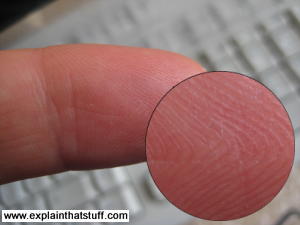
Photo: Your fingerprints are like unique keys you carry everywhere. In theory, no-one else has the same prints as you. The word “fingerprint” is a bit misleading: these ridges on the ends of your fingers and toes aren’t there to help people identify you, but to give you better grip on things you pick up or walk on.

It’s pretty obvious why we have fingerprints—the tiny friction ridges on the ends of our fingers and thumbs make it easier to grip things. By making our fingers rougher, these ridges increase the force of friction between our hands and the objects we hold, making it harder to drop things. You have fingerprints even before you’re born. In fact, fingerprints are completely formed by the time you’re seven months old in the womb. Unless you have accidents with your hands, your fingerprints remain the same throughout your life.

What makes fingerprints such a brilliant way of telling people apart is that they are virtually unique: fingerprints develop through an essentially random process according to the code in your DNA (the genetic recipe that tells your body how to develop). Because the environment in the womb also has an effect, even the prints of identical twins are slightly different.
While it’s possible that two people could be found who had identical fingerprints, the chances of this happening are so small as to be virtually negligible. In a criminal case, there are usually other pieces of forensic evidence that can be used with fingerprints to prove a person’s guilt or innocence beyond reasonable doubt.
Where fingerprints are being used to control access to something like a computer system, the chances of a random person having just the right fingerprint to gain entry are, generally speaking, too small to worry about—and much less the chance of someone guessing the right password or being able to break through a physical lock.

Enrollment and verification
Suppose you’re in charge of security for a large bank and you want to put a fingerprint scanning system on the main entry turnstile where your employees come in each morning. How exactly would it work?
There are two separate stages involved in using a system like this. First you have to go through a process called enrollment, where the system learns about all the people it will have to recognize each day. During enrollment, each person’s fingerprints are scanned, analyzed, and then stored in a coded form on a secure database. Typically it takes less than a half second to store a person’s prints and the system works for over 99 percent of typical users (the failure rate is higher for manual workers than for office workers).

Once enrollment is complete, the system is ready to use—and this is the second stage, known as verification. Anyone who wants to gain access has to put their finger on a scanner. The scanner takes their fingerprint, checks it against all the prints in the database stored during enrollment, and decides whether the person is entitled to gain access or not. Sophisticated fingerprint systems can verify and match up to 40,000 prints per second!

Photo: Fingerprints are best known for helping in criminal investigations. Photo by Sgt. Jess Kent courtesy of US Army.
How fingerprints are stored and compared
When fingerprints were first used systematically for criminal investigation in 1900, by Sir Edward Henry of the Metropolitan Police in London, England, they were compared slowly and laboriously by hand. You took a fingerprint from a crime scene and another fingerprint from your suspect and simply compared them under a magnifying glass or microscope. Unfortunately, fingerprints taken under different conditions can often look quite different—the one from the crime scene is much more likely to be incomplete or smudged—and comparing them to prove that they are identical (or different) sometimes takes great skill. That’s why forensic scientists (people who study evidence collected from crime scenes) developed a reliable system for matching fingerprints where they looked for between eight and sixteen distinct features. In the UK, two fingerprints need to match in all sixteen respects for the prints to be judged the same; in the United States, only eight features need to match.

Photo: A computer can compare fingerprints by identifying key features, then measuring the distances and angles between them. Algorithms can turn patterns like this into unique numeric codes.
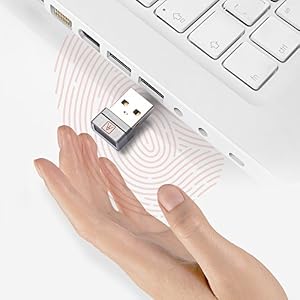
When a computer checks your fingerprints, there obviously isn’t a little person with a magnifying glass sitting inside, comparing your fingerprints with all the hundreds or thousands stored in the database! So how can a computer compare prints? During enrollment or verification, each print is analyzed for very specific features called minutiae, where the lines in your fingerprint terminate or split in two.
The computer measures the distances and angles between these features—a bit like drawing lines between them—and then uses an algorithm (mathematical process) to turn this information into a unique numeric code. Comparing fingerprints is then simply a matter of comparing their unique codes. If the codes match, the prints match, and the person gains access.
